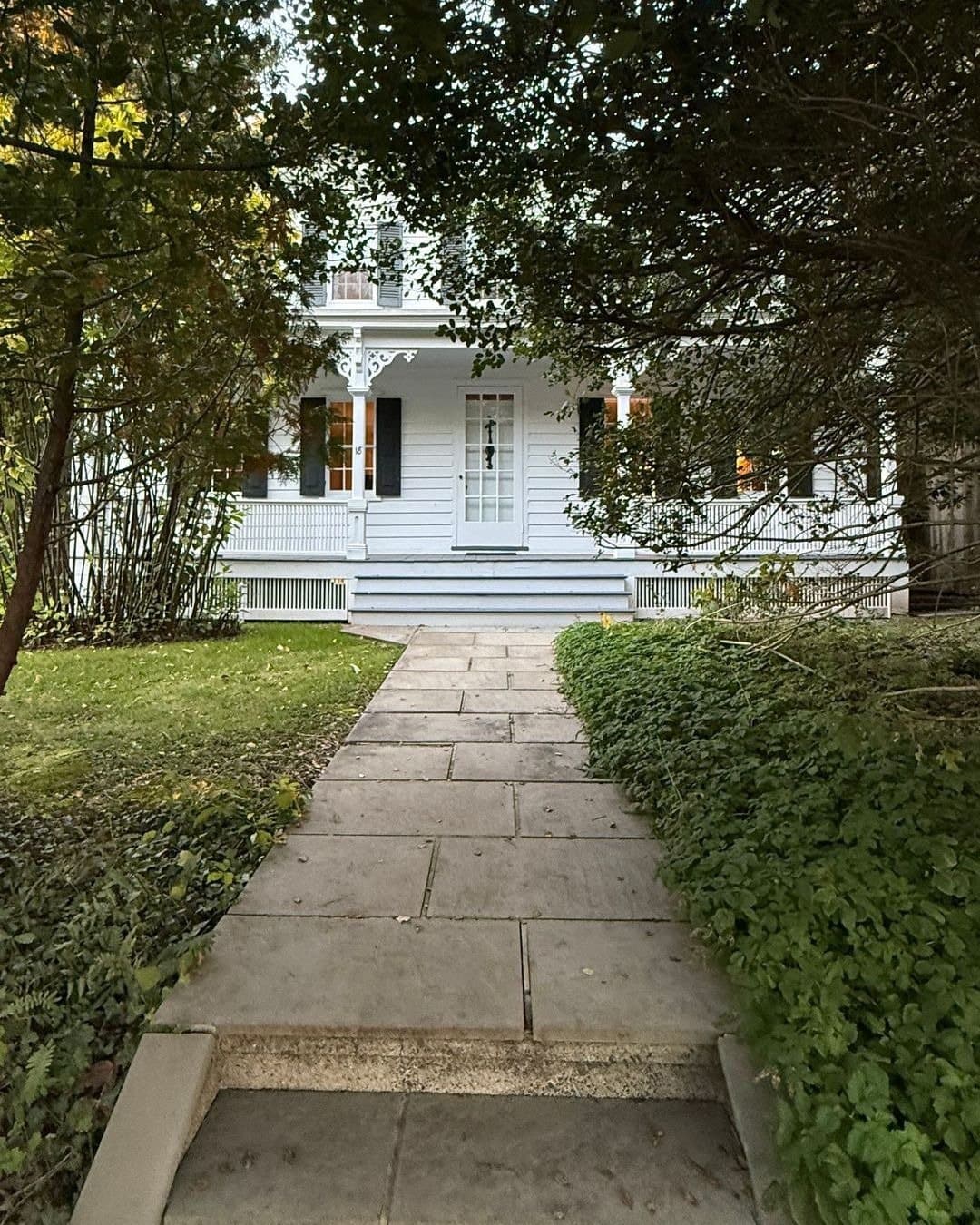
Christmas Day, 1852
A will from the owner's papers, signed by James S. Blackwell of Hopewell Township on Christmas Day 1852, leaves his wife Elizabeth "the Lot lately purchased for building." It orders his executors to see that "the contract is faithfully fulfilled," to paint the house inside and out, to build a barn "large enough for wagon with stabling for two horses" and to fence the lot. The will names no street; a typed note on the owner's copy says the house is 18 West Broad Street.
An inventory of his goods dated January 22, 1853 calls him deceased. It lists five horses, a yoke of oxen, seven milk cows and 24 young cattle. The borough's house-tour notes say he owned the 150-acre farm directly across Broad Street and that the house was begun in 1852 and finished in 1853.
Elizabeth Blackwell and her children
Elizabeth moved in with four surviving children and lived here 31 years, until 1884. The tour notes say her eldest son, Benjamin Drake Blackwell, died of wounds from the Battle of Monocacy in July 1864 with the 14th New Jersey, and that her daughter Permelia lived with her mother most of her life. Another daughter, Adelia, married the Hopewell blacksmith George W. Staples, whose shop stood first on the farm across the road.
Her husband's nephew John Van Cleve Blackwell bought the house from her estate and moved in for good about 1904.
Wilmer Moore, Antiques
John Van Cleve Blackwell's daughter Mary Edna married Wilmer Moore on June 1, 1909. He was a clerk at the Hopewell National Bank and a dealer in American antiques. A printed card from the owner's papers reads "Wilmer Moore, Antiques, 18 West Broad Street, Hopewell, New Jersey, Telephone 89." The 2000 tour notes say Mary lived in the house from the age of three until 1975 and that the Moores added an enclosed side porch.
Tom and Ann Johnson bought the house in January 1977, after 124 years in the Blackwell line by the tour notes. The Historical Society's draft brief is still a draft, and its owner list rests partly on family research.
January 1977
Tom and Ann Johnson bought the house on January 24, 1977, for $80,000, from the estate of Wilmer Moore. It had stood empty and unsold for about a year and a half. Their agent, in her first sale, had brought them over only to show it off. They walked back down the driveway past the barn and the carriage house and decided on the spot. Ann remembered it later as the most expensive house in town.
Moore's collection of Americana was sold at Parke-Bernet in New York the year they arrived. Ann recalled that he locked every room behind visitors with double and triple locks. The doors are still here.
The barn and the carriage house
Tom Johnson was an industrial designer who had left Detroit for Princeton. He and his son Terence cleaned out the barn and made it their first metal shop, which grew into T. Johnson Design. Their railings, gates and weather vanes stand around Hopewell: the library, Saint Alphonsus Church, the Calvary Baptist steeple, the Old School Baptist cemetery.
The carriage house held Ann's insurance-assistance business for 25 years. The loft upstairs is now a guest apartment.
West Broad Street, Hopewell
The house stands back from West Broad Street in Hopewell Borough, white clapboard with dark shutters, behind spruces and a lawn. The Old School Baptist Church of 1822 is on the same street.
Behind the house the lot holds a barn, a carriage house with a loft and a garden where water runs over the edge of a stone disc into ferns and flagstone. In the barn a hand-hewn beam crosses the ceiling and a sliding door with a row of panes catches the light.