The Story
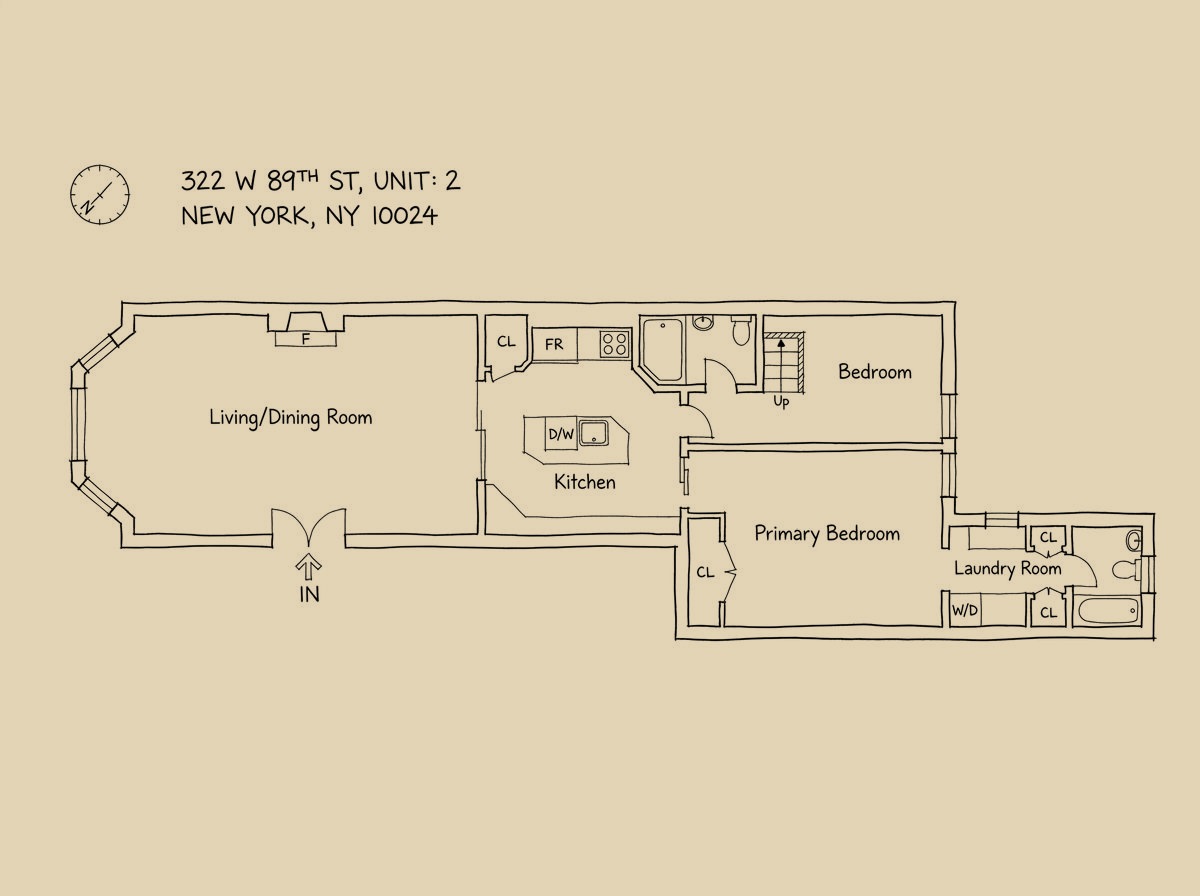
The parlor floor faces north over West 89th Street through a three sided bay, which on this side of the street is the light you want: steady all day, no glare, and the trees in it from spring to autumn. The living room keeps its high ceilings, a decorative fireplace and hardwood floors, and the pocket doors between the rooms have been restored and still work. Two bedrooms, both generously sized, and two renovated bathrooms. It comes furnished, for six months to a year, with no building fees.
The kitchen is new: custom cabinetry and countertops, an induction stove, a dishwasher and a breakfast bar island. There is a washer and dryer in the apartment. The second bedroom carries a Murphy bed, which makes it an office that converts for guests rather than a room that has to choose.
One of four left from a row of seven
Frederick T. Camp drew seven houses here for the developer Garrett Van Cleve under a new building application filed in 1889, and they went up in 1889 and 1890: brick and brownstone, twenty to twenty two feet wide, four storeys over raised basements, under steeply pitched roofs laid in hexagonal slate with pedimented dormers and a stepped parapet between each house. They ran from No. 312 to No. 324.
In 1921 the three in the middle came down for George F. Pelham's nine storey apartment house. Four of Camp's houses survive, and No. 322 is the one the Landmarks Preservation Commission records as retaining its stoop, with a three sided bay set to the eastern side of the facade under a balustrade, a two window pedimented dormer above it and an eyebrow window above the flush bay. The street number is carved into the stonework of the entrance surround. When the house was divided into apartments in 1958, the stoop stayed, which is why the parlor floor still opens off the entrance it was drawn for.
The block, and who was in the house
From 1915 the pianist and voice coach Norman Winter owned No. 322 and ran it as a boarding house for people working in music, with his own voice studio inside. The soprano Edythe Le Bermuth, who had sung Marguerite, Violetta and Manon, moved in during the summer of 1921. So did Jean Theslof, a Finnish baritone who shot in four events at the 1924 Paris Olympics, finishing fourth in the fifty metre rifle prone, then settled in New York and founded a singing school.
The south side of this block reads as a catalogue of the Upper West Side: Rosario Candela's 1922 apartment house at 302, Joseph H. Taft's Flemish Revival pair at 308 and 310, Camp's row, Pelham's block, Ralph S. Townsend's five houses at 326 to 334, and at the Riverside Drive corner the Isaac L. Rice Mansion of 1901 to 1903 by Herts and Tallant, one of two freestanding mansions left on the Drive and a designated landmark since 1980. Where the street meets the park stands the Soldiers and Sailors Monument, dedicated on Memorial Day 1902. The whole of it sits inside the Riverside West End Historic District, designated in December 1989.
 Rented