Across from the park
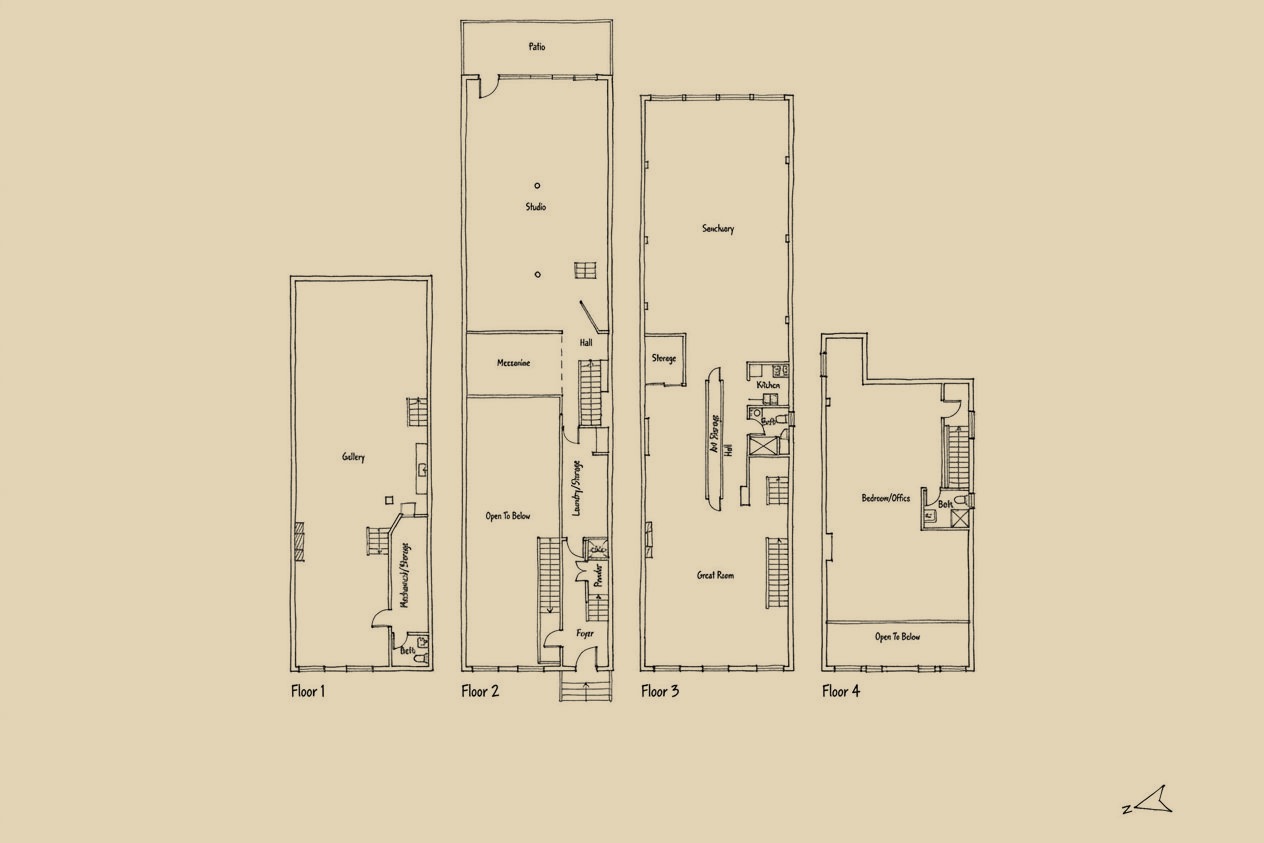
The building stands on Forsyth Street across from Sara D. Roosevelt Park, so its front looks west over the park's trees, and the top floor takes that light through three Gothic-arched windows and two round ones. Inside, the listing counts four levels and about 6,800 square feet, most of it double height, with 22-foot windows, four skylights, two sets of steel casements and cast-iron columns. The lot is 25.25 feet by 100.25 feet.
The walls are exposed stone and brick, some of it whitewashed, some finished in lime plaster. The floors are concrete, ebony-stained wood, and in one studio boards still covered in paint. There are two kitchens and two and a half baths.
A house before a synagogue
The listing says the building was constructed in 1874 as a synagogue. Daytonian in Manhattan finds a three-story brick house at No. 80 Forsyth Street, with a rear house behind it, during the Civil War. In the summer of 1874 the owner, C. Schwartz, hired the builder A. Shappel to turn the front of the house into a store for Anthony Schwartz, a $200 job; by 1875 the store sold furniture.
On March 28, 1881, Congregation Kol Israel Anshe Poland bought the building for $12,000. By the summer of 1882 the congregation had remade it, keeping the Italianate pressed-metal cornice and cutting two-story Gothic-arched windows with round openings between them. The wrought-iron fire escapes were made with Stars of David, and one still shows in the ironwork on the front. A mikvah went in on the ground floor where the store had been, run under a ten-year lease by Solomon B. Oschinsky; in 1888 a judge ruled that because the baths were run as a business, the synagogue owed tax on the building.
After the congregations
Kol Israel Anshe Poland sold No. 80 in 1892 and moved to Nos. 20-22 Forsyth Street. Beth Hamidrash Sha'arei Torah took the building and in 1906 hired the architect Nathan Langer for alterations. By 1930 the congregation had gone and a store occupied the ground floor; by 1946 the Manhattan Store Fixtures Company owned what was by then a loft building.
In 1963 the painters Pat Passlof and Milton Resnick bought it. Passlof had studied with Willem de Kooning, who introduced her to Resnick in 1948. She worked here, and they divided the building into two apartments, a duplex in the basement and ground floor and another above; Resnick's own studio was in a second former synagogue around the corner on Eldridge Street, now the Milton Resnick and Pat Passlof Foundation. Resnick died in 2004 and Passlof in 2011. The building sold in 2013 and has since been a sculptor's studio, where the fiber works in the photographs are made.