The Story
Adelphi Street is one of the few blocks in Brooklyn where the wood houses survived. The city's own lot record dates 333 Adelphi to 1855 and the row around it to the decade either side: 329 and 331 in 1848, 337 through 351 in 1859. They were speculative houses, built quickly and cheaply in timber at a moment when brownstone was becoming the expectation, and they were never meant to outlast the fashion.
This one was put up by Edward W. Genung, a builder-developer working across the transition from Greek Revival to Italianate, and the porch is where he spent his attention: brackets cut by hand on a jig saw, posts squared and chamfered. The Landmarks Preservation Commission drew the Fort Greene Historic District around the block in 1978. The house has been a boarding house, a dentist's residence, a kindergarten run on the Froebel method, and for two years in the early thirties a spiritual society that held lectures in the parlour.
Inside
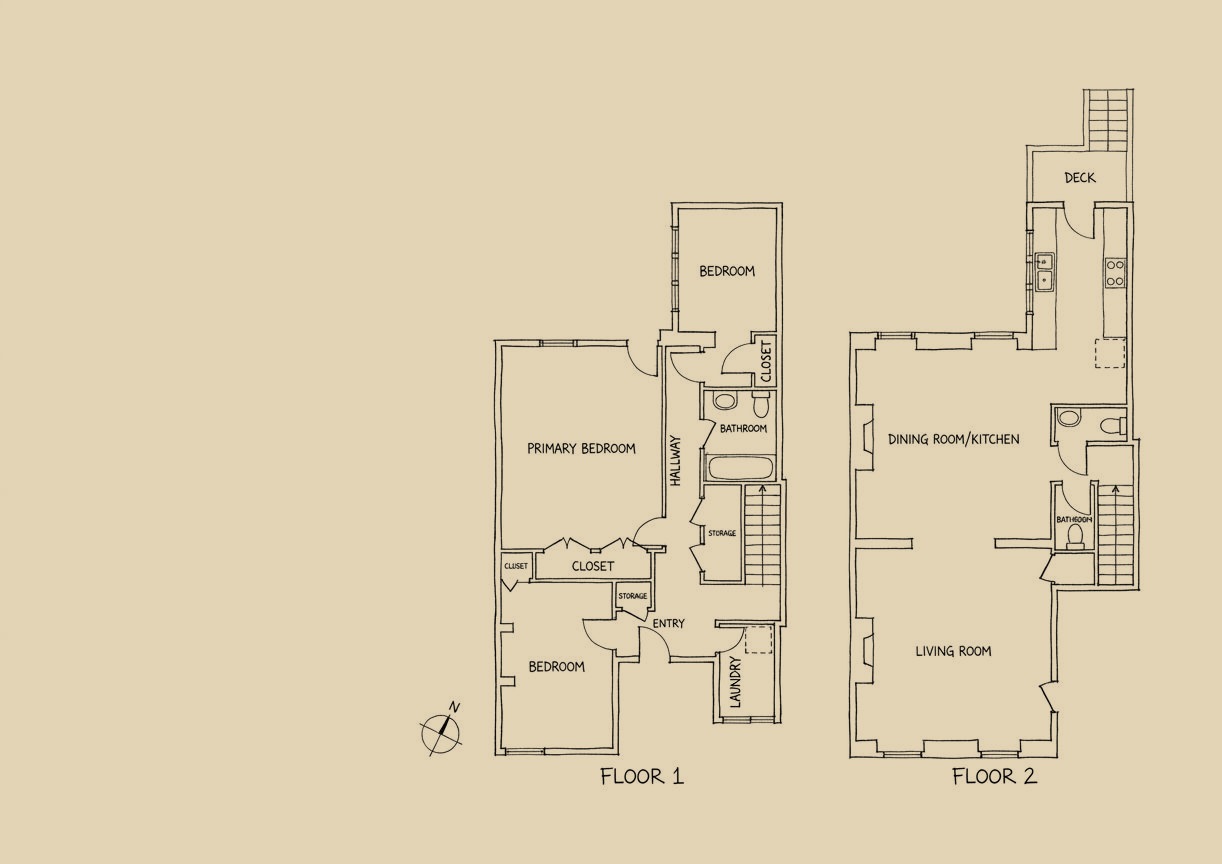
The parlour floor has the plaster cornice and the cast-iron mantel, and the light comes from both ends of the house. The kitchen is a galley in deep green, running the full depth to a glazed door and the garden behind it. Below, the rooms are simpler and quieter: white walls, a bed under a round mirror, a desk in the alcove.
The floor above is given over to one room of nearly twenty-four feet by twenty-eight, the kitchen at one end in deep green counters and the dining at the other, with a door to a deck and a stair down to the garden. Below, the three bedrooms are quieter: white walls, a bed under a round mirror, a desk in the alcove. Twenty-five feet of lot means a garden with real width to it, paved and planted, with the backs of the neighbouring houses closing it in.
Taking It
Rove Travel manages the house and holds the calendar. Thirty nights is the minimum; stays past sixty get a mid-stay clean. Dogs under thirty pounds are allowed, cats are not, and nobody wears shoes indoors.